
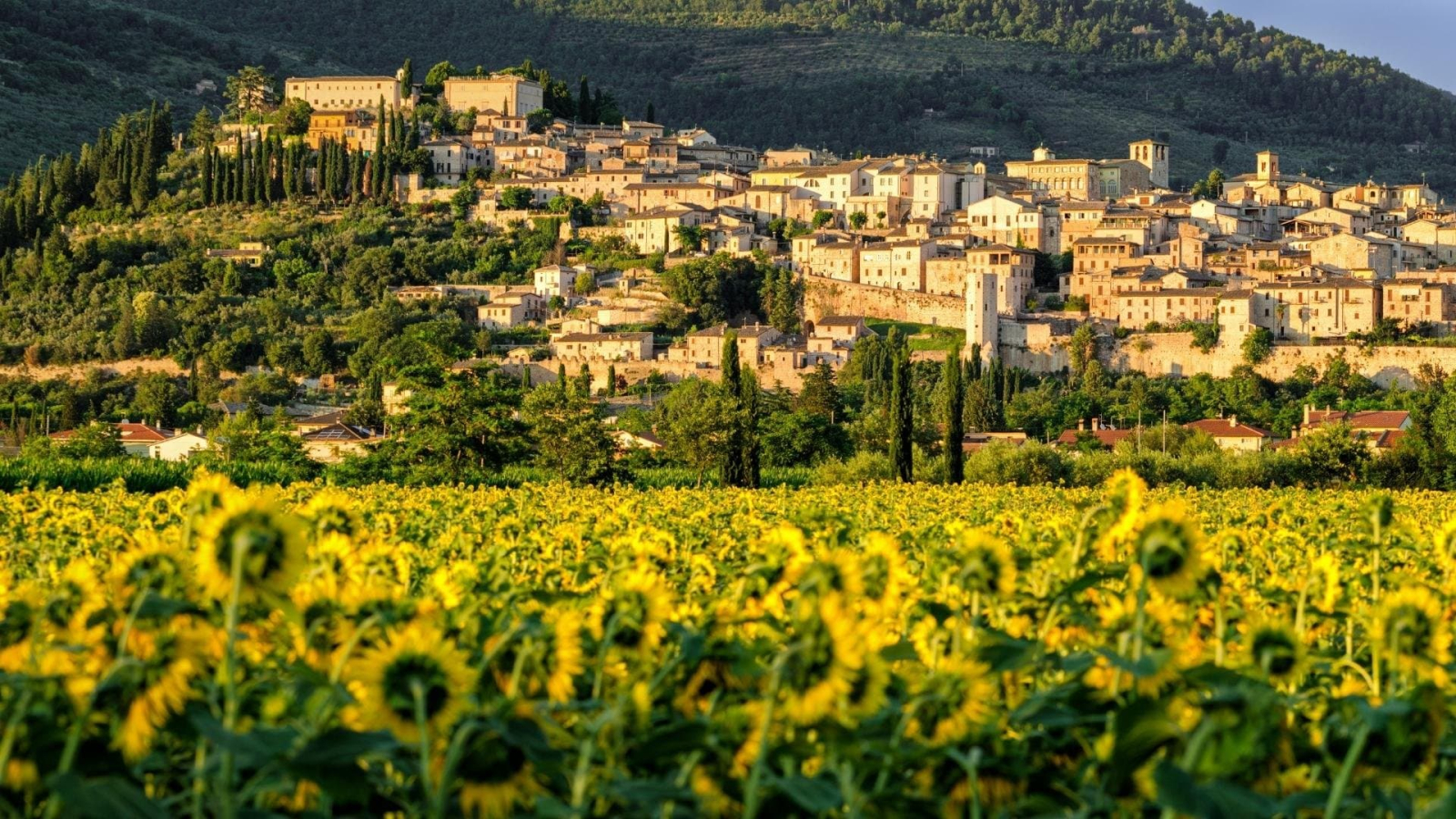
Umbria: The Green Heart of Italy
“Umbria, the land of soft shadows,” Pavel Muratov described it in his “Images of Italy.” Hidden away from the bustle of major tourist flows, this land is filled with true beauty, history, and the amazing aura of “real Italy.”
Umbria is one of the few landlocked Italian regions. It is often called the “green heart of the country”: the hills, olive groves, vineyards, and medieval towns have retained their original character, as if time has slowed down to allow one to savor every detail.
Here, every city is like an open-air museum.
Perugia, the region’s capital, combines Etruscan heritage, Gothic architecture, and the vibrant atmosphere of a university town. It hosts renowned festivals, including the chocolate festival Eurochocolate.
Assisi, the spiritual heart of Umbria and the birthplace of St. Francis, enchants with its harmony and tranquility. The Basilica of San Francesco, decorated with frescoes by Giotto, is considered one of the most important shrines in the Christian world.
Orvieto, perched on a volcanic tuff cliff, seems to float above the valleys. Its Gothic cathedral is a masterpiece of Italian architecture, and underground caves tell the stories of the Etruscans who lived here long before the founding of Rome.
Spoleto is an exquisite Umbrian town where antiquity and art exist in exquisite balance. Its silhouette is recognizable by the Roman bridge Ponte delle Torri and the majestic Albornoziana fortress, towering over the valley. Spoleto is renowned for its rich cultural life: it hosts the popular Festival dei Due Mondi (Festival of the Two Worlds), which for several weeks transforms the city into an arena for world art – from classical music to contemporary theatre and performance.
Gubbio, nestled on the slopes of Mount Ingino, is one of Umbria’s most picturesque medieval towns. It is renowned for its Palazzo dei Consoli, one of Italy’s most spectacular Gothic civic buildings, as well as for the vibrant traditions that still define its character. Among them is the Corsa dei Ceri, a vibrant historical festival included in the List of Intangible Heritage of Italy, during which giant wooden “candles” are carried through the streets in honor of San Ubaldo.
Behind the allure of medieval towns lies the region’s rich historical heritage, dating back to the Roman Empire. One of its most impressive historical sites is Lake Trasimeno. It was here in 217 BC that the Romans built the Roman Empire. A legendary battle took place in 100 BCE, when Hannibal’s army staged one of the largest ambushes in the history of Ancient Rome, inflicting a crushing defeat on the Romans.
Umbria enchants with its depths. Recommended for those seeking authenticity: quiet villages, wineries with family traditions, truffles, olive oil, and sunsets painting the hills in gold and terracotta hues.
Calendar of the region’s main cultural events
Corsa dei Ceri – a historical festival, May 15, 2026, Gubbio.
Festival dei Due Mondi – one of the most prestigious cultural events in Italy, June 26 to July 12, 2026, Spoleto.
Umbria Jazz Festival 2026 – a significant jazz event in Europe, July 3 to 12, 2026, Perugia.
Eurochocolate – International Chocolate Festival, November 13–22, 2026, Perugia.
Recommended Hotels in the Region
Altarocca Wine Resort is a stylish, adults-only wine resort in the picturesque Umbrian hills near Orvieto, surrounded by vineyards and olive groves. The resort combines the spirit of an Italian country estate with privacy and modern comfort. The hotel offers approximately 55 rooms, suites, and villas, all elegantly decorated in an eco-style; many categories feature terraces and vineyard views. Key features of the resort include its own organic winery, wine and olive oil tastings, the Invinum restaurant serving Umbrian cuisine, and a wellness and spa center with wine therapy, massages, and panoramic pools. Recommended for a romantic and wellness getaway in a slow luxury atmosphere.
BOOKING:
Ekaterina Kanevskaya
[email protected]
Maria Zimina
[email protected]
Assel Nurkebayeva
[email protected]